5 WAYS TO DECLUTTER YOUR DESIGN DECISIONS
For the natural-born minimalists among us, the benefits of decluttering are well-known. Marie Kondo – world renowned professional organiser, consultant and author of numerous books on the subject is just one of many who speaks of the transformative benefits a tidy environment can offer. But to really harness the power of the concept, your design decisions need to take a ‘decluttered’ approach too.
For one thing, when a space is visually quiet, your brain doesn’t need to use as much processing power – alongside impeccable organisation, design needs to essentially disappear so that living life can happen seamlessly around it. That doesn’t mean things can’t be beautiful or eye-catching, it’s more about minimising visual overwhelm, creating ease in finding the things that you need and setting up spaces to make sure less time is spent trying to tidy or find a place for things.
To do this effectively, the decluttering needs to begin within your design decisions. We live in a time where we have access to endless images of beautiful interiors (hello Pinterest) which is great for inspiration but can quickly become overwhelming. Setting parameters within the design process helps to simplify (or declutter) the many decisions that need to be made which not only eases cognitive load but allows for fewer opportunities for things to go wrong. Here are five ways to declutter your design decisions (and therefore your home) as you move into your next project.
1) Establish Your ‘North Star’
Choose one guiding design principle to keep coming back to. With so much inspiration at our fingertips it becomes all too easy to deviate from the plan so getting really clear on your goal from the get-go is key. Goals don’t solely have to be about style either – maybe it’s about how easy the space is to clean or how much the space supports culinary experimentation. Then you can get clear on how you’d like the space to look and feel – minimal or luxurious, trending or timeless, light and airy or dark and enveloping and so on. Once you set these parameters, every design decision to follow has a framework to fit into that will help to quickly eliminate anything that doesn’t fit with the end goal.
2) Fix Your Finishes
Mixing finishes isn’t necessarily a faux pas but it does have an impact on design. For one thing, it can prolong design decisions trying to find the finishes that work well together. For another, it can actually cause visual overstimulation if not executed well. Finishes are undoubtedly a design decision that you can simplify with two simple but highly effective rules that we’ve found to work well for our clients and save a few headaches as well as the potential for visual overwhelm:
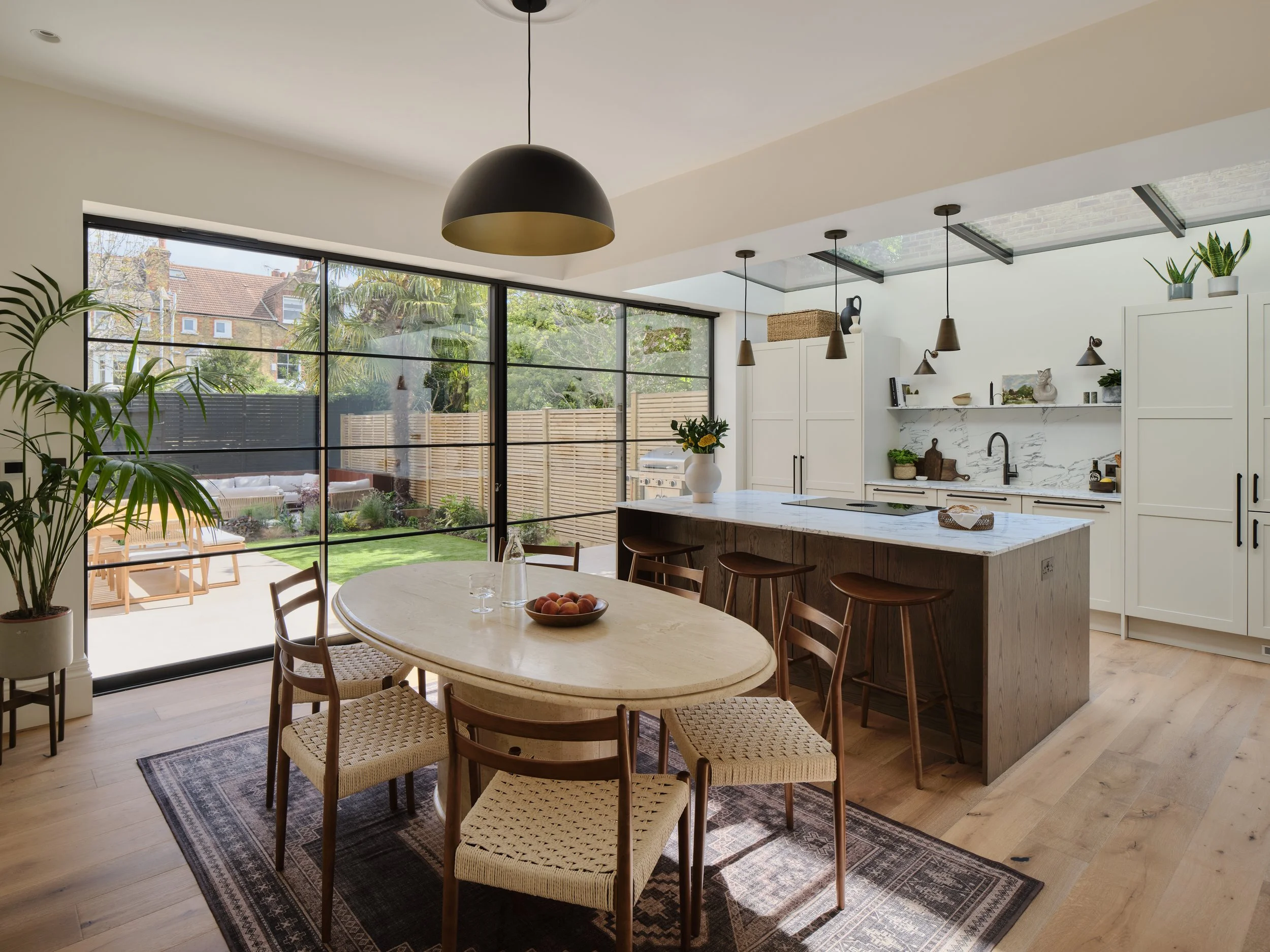
Rule number 1: Use one stone for your kitchen island, worktops, and splashback instead of mixing three materials.
Rule number 2: Stick to one timber finish for all cabinetry for a considered and coherent look.
3) Set Storage Goals
One of the most obvious ways to keep things clutter-free quite literally is with clever storage. Sometimes it’s hard to know what that looks like until you’ve started using a space so it can feel a bit chicken and egg, but after executing multiple successful projects our golden nuggets are:
Perishables in one place – Create a full-height larder wall instead of scattered cupboards, ideally positioned near to cold food storage so that food shopping can be unpacked and accessed from one place. This not only makes the design feel intentional, it makes it much quicker to find what you need in a busy kitchen.
Countertop appliances also in one place – Build an integrated appliance garage to free up worktop space and contain visual clutter in one controlled zone. Include a power socket inside so appliances can stay plugged in and ready to use.
Make it easy to use – Choose deep drawers, slim pullouts and internal dividers instead of cupboards with shelves so that you can actually see what you have. Meanwhile positioning is key – for example keep cooking oils in a slim pullout next to the hob and spices in a drawer close-by too.
4) Know How To Maximise
It sounds obvious but maximising space is so much more than just cramming in as much storage as you possibly can. It’s about working with the space as cleverly as possible. Consider where light enters the space before committing to upper cabinetry – a wall cabinet positioned too close to a window, or a tall unit sitting in the fall of a rooflight, can significantly compromise natural light in a way that's very hard to undo. Sometimes the smartest storage decision is knowing where not to put it.
Make the kitchen island work as hard as possible – this is a multifunctional feature if ever there was one – storage, prep and a dining space can all happily co-exist here. And last but not least, consider pocket doors for pantries if budget permits rather than swing doors that take up floorspace. With some thought, every element of the kitchen can always work harder and smarter, it just takes some planning.
5) Batch Decision-Making
With every project there are always more decisions than you might first anticipate and decision fatigue is common. We suggest creating ‘batches’ of design decisions. For example, dedicate a decision-making session entirely to a category such as lighting, hardware, storage and so on.
If you’d like to find out more about how to declutter your design decisions and make your space work smart as well as hard, you can get in touch here to speak to one of our experienced kitchen designers.